It is August in East Texas, the loblollies are throwing shade over ground that is still 95 degrees at noon, and somewhere on a million-plus acres of national forest a mature buck is walking a creek bottom that nobody has a stand on. That is the whole pitch for public-land whitetail out here: the deer are real, the access is legal and cheap, and most hunters never leave the road. This is your guide to the four national forests of the Pineywoods, how the U.S. Forest Service and Texas Parks & Wildlife split the rules between them, and — more to the point — how you actually kill a pressured public buck in country that hides deer for a living.
First, the rules that shape every tactic
Before you drop a waypoint, understand who owns what. The four East Texas national forests — Sam Houston, Davy Crockett, Angelina, and Sabine — are federal land run by the U.S. Forest Service. But TPWD leases big blocks of that ground and manages them as Wildlife Management Areas, and that partnership is exactly what makes them huntable. Get the framework right and half the crowd disappears.
What you need to hunt the WMA units: a Texas hunting license and the Annual Public Hunting (APH) Permit — currently $48, good for the full license year, and it opens roughly a million acres across 180-plus areas statewide, not just these forests. That single permit is the cheapest deer lease in Texas. Buy it before you go; a warden checking a national-forest WMA will ask for it.
Two ways in. Most of this ground is walk-in — show up with your license and APH permit and hunt, no reservation. Some units also run drawn hunts through TPWD's public hunt draw system, where a limited number of hunters get assigned dates for lower-pressure gun hunts. Applications for the drawn hunts open in summer; if you are reading this in August, check whether the unit you want has a draw category still open. If you drew a tag, you are hunting a managed, capped crowd — treat it like a semi-private hunt. If you are walking in, plan your whole strategy around one thing: everybody else walked in too.
The two federal rules that change how you hunt. On National Forest land in Texas, baiting is illegal — no corn, no protein, no hunting over a baited spot. That levels the field in a way private-lease hunters forget: out here you win on woodsmanship, not a feeder timer. Second, stands must be portable — you may leave a stand up to 72 hours, but you cannot permanently affix it or screw steps into a tree. That single regulation is why the mobile hunter owns this country. A hang-on you carry in and out beats a ladder stand somebody chained to a pine in October and abandoned.
Your four options — and the character of each
All four forests share the same DNA: pine plantation for cover, hardwood drainages for food, and deer that live on the seam between them. But they do not hunt the same.
Sam Houston National Forest (the WMA runs about 162,984 acres) — Walker, San Jacinto, and Montgomery counties, split into the Raven, San Jacinto, and Tenaha ranger districts. It is the biggest, closest-to-Houston, and therefore the most pressured of the four. That is not a reason to skip it — it is a reason to walk farther. A few zones that have earned their reputation:
- Big Creek Scenic Area (San Jacinto District): along the East Fork of the San Jacinto River southwest of Coldspring. Mature bottomland hardwoods throw heavy acorns in a good mast year and pull deer out of the surrounding pine through both archery and gun seasons. Access off Forest Road 217 gets you to the south end; hike at least a half-mile in to clear road pressure. Hunters report bucks in the 110–130-inch class here, mostly during the November rut.
- Northern Lake Conroe shoreline (Montgomery County side): around Double Lake and the FM 1374 corridor. Deer use the water's edge as a travel route in a dry fall, and the creek drainages feeding the lake build natural funnels. Hunt the points of hardwood ridges that jut toward water.
- Stubblefield vicinity: mixed pine-hardwood around Stubblefield Lake and the Cagle Road (FM 1375) bottoms. An early-archery play, before November pressure shoves deer into the thick stuff. Look for oak flats sitting against dense young pine.
- Raven District east of Huntsville (Walker County): compartments along FM 2296 and the drainages into Harmon Creek. Fewer campgrounds, harder access, less pressure — which reads as more natural deer behavior during the pre-rut scrape phase.
Davy Crockett National Forest — hunt the Alabama Creek WMA — roughly a 160,000-acre forest in Houston and Trinity counties, with TPWD managing the Alabama Creek unit inside it. Classic Pineywoods bottoms along the Neches drainage. It sees real pressure on the gun opener but empties out midweek and in the late season. Both walk-in APH access and drawn gun hunts have historically been part of the picture here — verify the current year's structure before you commit.
Angelina National Forest — hunt the Bannister WMA (and the nearby Angelina-Neches/Dam B unit) — a roughly 153,000-acre forest wrapped around Sam Rayburn Reservoir in Angelina, Jasper, Nacogdoches, and San Augustine counties. The reservoir edges and the creek arms feeding it create the kind of water-driven funnels that concentrate deer movement in a dry fall. Big, quiet country if you get away from the boat-ramp crowd.
Sabine National Forest — hunt the Moore Plantation WMA (about 27,000 acres) — up against the Toledo Bend line in Sabine, Shelby, Jasper, and Newton counties. Moore Plantation is one of the genuinely underrated walk-in rifle-deer hunts on public ground in Texas — you need your license and APH permit, no reservation, and you can just go. Farthest from the metro crowds, which is exactly why a hunter willing to drive finds elbow room here.

Read the ground: one strategy works on all four
Districts and unit names change; deer behavior does not. Everywhere in the Pineywoods the same thing holds deer: the transition line where a thick pine plantation — often an impenetrable 20-year-old stand planted for timber — meets a mature hardwood drainage full of white and water oaks. Deer bed in the pine and stage into the hardwoods to feed at first and last light. Hunt that edge. Do not bury yourself in the deep timber and do not sit the open hardwood flat 200 yards off the bedding — sit the seam.
The Forest Service divides each forest into numbered timber compartments, and the compartment maps tell you stand age and species. Layer those over satellite imagery in your GPS mapping app and you can pick out loblolly bedding cover versus a white-oak flat before you ever lace your boots. Find a creek drainage with mature hardwoods pinched against young pine, and you have found a stand site. That work is free and you can do it tonight from the couch — see our breakdown of when to start scouting for fall for the timing.
The pressured-public playbook: if this, then that
Public whitetail is a chess match against other hunters as much as against deer. Play the read, not the calendar.
If it is early archery season (typically early October into late November), then hunt food and stay invisible. Deer are on acorns and browse edges, patternable and relatively undisturbed. Run cameras on white-oak flats and creek crossings in September and let them tell you which trees are dropping. Your shot window is 20–40 yards, so your stand has to sit directly over a travel corridor or a tight lane at the hardwood edge. Scent discipline matters most now because calm deer are hunting with their nose.
If the wind and thermals are wrong, then do not hunt the stand — period. This is the one variable that overrides everything else, and it is where most public hunters beat themselves. Prevailing fall wind out here runs north to northwest, but the daily thermal will lie to you: air rises up the slopes after sunrise as the ground heats, and sinks back down the drainages at last light as it cools. So a morning setup wants you above the bedding with your scent climbing away; an evening setup on that same spot can dump your scent straight down into the deer. Carry two or three stand sites for every wind and pick the one the day gives you. A perfect spot hunted on the wrong wind is a spot you just burned.
If it is the gun opener and the woods fill up, then go where they won't. Opening-weekend pressure shoves deer into the thickest, nastiest, hardest-to-reach cover — young pine plantations, creek-bottom tangles, the corners that require a 1.5–2-mile walk from the nearest road. Deer that were patternable in October vanish from the food and go nocturnal in the high-traffic zones. Use your mapping app to find a drainage a mile-plus off the road and let the crowd push deer to you.
If it is mid-November, then hunt the rut and stop hunting food. Peak breeding in this country typically runs from about November 12 into early December, and it overrides a buck's caution — a buck locked on an estrous doe will move in daylight even under pressure. Set up on the downwind edge of doe bedding, sit all day if you can stand it, and let cruising bucks check the area for you. Weekday sits during the rut are gold because the pressure drops. Realistic shot lanes open to 50–150 yards in the hardwood corridors, so this is your rifle's season.
If the bottoms are flooded — and after a wet year they will be — then hunt the high ground, then be ready when it drops. Heavy rain raises the creeks and pushes deer off the drowned bottoms onto adjacent pine ridges and upland hardwood patches that normally hold nothing. When the water recedes in late fall, deer pour back into the exposed bottoms to feed on what was underwater. Being in position for that post-flood window is one of the most reliable edges on public ground.
If it is late season (December into January), then go back to food and enjoy the quiet. Pressure falls off a cliff after Thanksgiving, deer settle back into feeding patterns, and any remaining natural food — late acorns, browse regrowth in old burns or forest openings — concentrates cold, hungry deer on sunny afternoons. Post-rut Pineywoods hunting is underrated precisely because everyone else has quit.
A month-by-month scouting timeline
August — digital scouting. This is where the season is won. Spend three or four hours in your mapping app studying compartment maps and satellite imagery. Pick two or three sites that match the transition-zone profile — pine bedding against hardwood food near water. Drop waypoints before you make a single trip.
Early September — boot scouting. It is miserable in the 90s, but deer aren't nocturnal yet and sign is fresh. Look for established trails through the transition zone, old rub lines (big rubs get hit again year after year), and white oaks setting acorns. Hang two or three trail cameras — one on a creek crossing, one on a white-oak flat — and get in and out in under 45 minutes to keep your scent low. If you are still deciding what to hang, our guide to the best cellular trail camera for summer scouting walks through why we lean on the units below.
Late September / early October — adjust. Pull cards. Multiple does on a food source in legal light is a stand. All-nocturnal activity means the deer are pressured or the food isn't pulling — move. Hang stands now and cut only the shooting lanes you absolutely need; every branch you cut tells a mature deer you were there.
October — hunt and refine. Hit your best food stands on the first cold fronts — the first two weeks are often your cleanest crack at a mature buck before pressure lands. After about October 20, shift to scrape lines; pre-rut sign-posting ramps up in the last week of the month. Find a primary scrape with a licking branch on a trail intersection or creek crossing and sit 20–30 yards downwind.
November — rut. All-day weekday sits on doe bedding. Go farther in than you want to, hunt longer than feels reasonable, and do not move when it goes quiet.
December–January — late season. Back to food, back to comfort, back to having the woods to yourself.
Gear that earns its place on public ground
Baiting is off the table and permanent stands are illegal, so your kit has to make you mobile, patient, and scent-smart. Nothing here is magic — it just removes the excuses.
Wear a harness. Every sit, every climb. This comes before the gear list because it matters more than anything on it. Mobile hunting means you are climbing a different tree most times you go in, often in the dark, often tired — and the falls that hurt people happen on the way up and the way down, not sitting in the saddle. Wear a full-body harness and stay connected to a lifeline or tether from the moment your boots leave the ground until they are back on it. We do not stock harnesses or lifelines, so buy one from a treestand-safety specialist, learn it in your backyard before you trust it in the dark, and retire it on the manufacturer's schedule. No buck on this list of forests is worth the alternative.
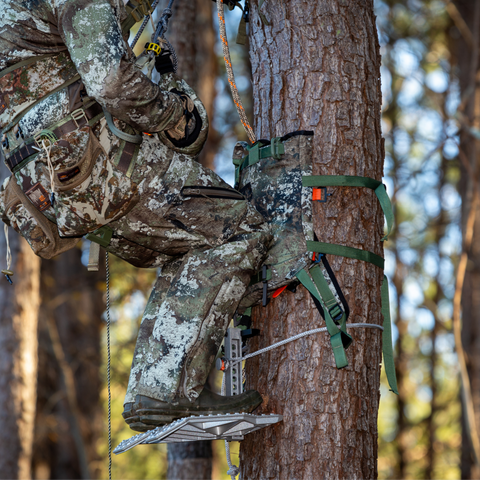
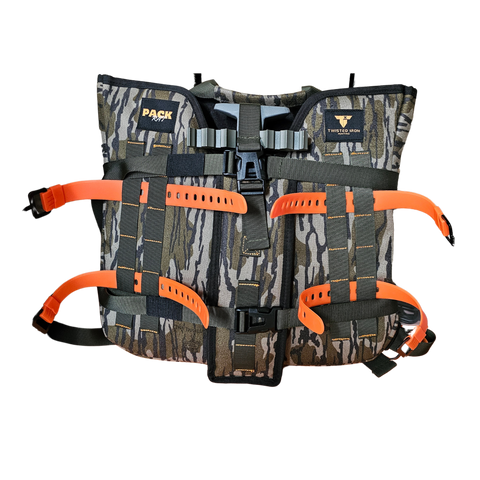
Go mobile. Because you can only leave a stand 72 hours and can't screw into a tree, a lightweight setup you carry in and out is the tool that fits both the rules and the tactics. A saddle platform and a set of climbing sticks let you hang over a fresh scrape or a wind-right funnel and pull out clean — no chained-up ladder announcing your spot to the next guy. When there is no tree worth climbing — and in cutover pine there often isn't — a low-profile ground setup does the job. A 360-degree one-way see-through ground blind hides movement in open hardwood flats, and a low seat you can carry in one hand keeps you silent and stable on an all-day rut sit. Shop the full lineup of hunting blinds and stands before you pick.
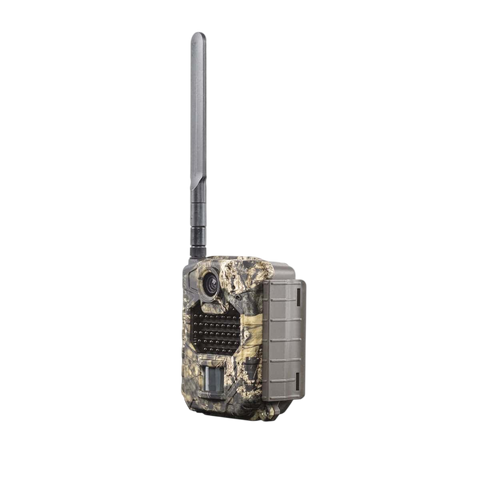
Let cameras do the walking. Since you can't bait, your cameras go on natural funnels — a creek crossing, a white-oak flat, a pinch between bedding and water — not over a pile of corn. Cellular cameras keep you out of the woods and out of the deer's nose between hunts, which on pressured ground is worth more than more sits. We hang the solar-charged Bushnell Cellucore 20 Dual SIM Solar because the dual-carrier SIM finds a signal in dead-zone Pineywoods bottoms and the solar panel means you are not walking in to swap batteries; a dual-carrier AW1-V refurbished cellular camera is a lower-cost way to cover a second funnel. On the cameras that still run internal cells, a spare 6.4V LiFePO4 rechargeable pack keeps a remote set live through the whole season. See the full trail-camera lineup and our test notes on the best trail cameras for summer scouting.
Beat the bugs and the wind. Heavy spring rain means the mosquitoes will still be brutal into early October — a clip-on repeller is close to mandatory for an archery sitter trying to hold still in the bottoms; don't let bugs run you out of a good stand. And with wet, humid air holding your scent low and slow, wind discipline is not optional. Hunt the thermals, play the crosswind, and keep your camo and layers clean between sits — start with the whitetail deer hunting gear collection.
Licenses, access, and doing it right
To hunt these national-forest WMA units legally you need a Texas hunting license and the Annual Public Hunting Permit ($48), plus current compliance with all TPWD bag limits and season dates for the specific unit. Remember the federal layer too: no baiting, portable stands only, and pack out what you pack in. Dispersed camping is allowed across most of the National Forest at no fee outside developed campgrounds, so you can hunt-camp deep and skip the campground crowd entirely. Season structure, permit rules, and unit boundaries update every year — confirm them against the current Public Hunting Map Booklet (released each August) and TPWD's unit maps before you go, and cross-check the Texas deer season dates and zones for this year.
One more thing, hunter to hunter: this ground is a shared resource, and it stays good only if we treat it that way. Pull your cameras and stands at season's end, leave no trash in the bottoms, respect the private in-holdings marked on the map, and be square with every warden and every hunter you meet on the trail. The person who hunts the Pineywoods right this year is the reason it is still worth hunting next year.
Put in the August map hours, hang cameras in September, and be willing to walk a mile farther than the next guy in November. The deer are out there on all four of these forests — Sam Houston, Davy Crockett, Angelina, and Sabine — living where the crowd won't follow. The work decides who tags out and who drives home telling stories about the one that never showed. Good luck out there, and shoot straight.
Frequently asked questions
Do I need the Annual Public Hunting Permit to hunt East Texas national forests?
To hunt the TPWD-managed WMA units on these forests — Sam Houston National Forest WMA, Alabama Creek (Davy Crockett), Bannister (Angelina), and Moore Plantation (Sabine) — yes: you need a Texas hunting license and the $48 Annual Public Hunting Permit. Some units also offer drawn gun hunts through TPWD's public hunt draw system. Always confirm the current requirement for the specific unit before you go.
Can I use bait or a permanent stand on national forest land?
No. Baiting is prohibited on the National Forests and Grasslands in Texas, and stands must be portable — you may leave one up to 72 hours but cannot permanently affix it or screw steps into a tree. Mobile, hang-and-hunt setups are the way to hunt this ground.
Which forest is best for a walk-in rifle deer hunt?
Moore Plantation WMA in Sabine National Forest is one of the best-known walk-in rifle deer hunts on Texas public land — license and APH permit, no reservation required. Sam Houston is the biggest and closest to Houston but the most pressured; Alabama Creek and Bannister sit farther out and thin the crowd.
When is the rut in the Pineywoods?
Peak breeding in East Texas typically runs from about November 12 into early December. Weekday sits during that window, on the downwind edge of doe bedding, are your best odds at a mature buck on pressured public ground.