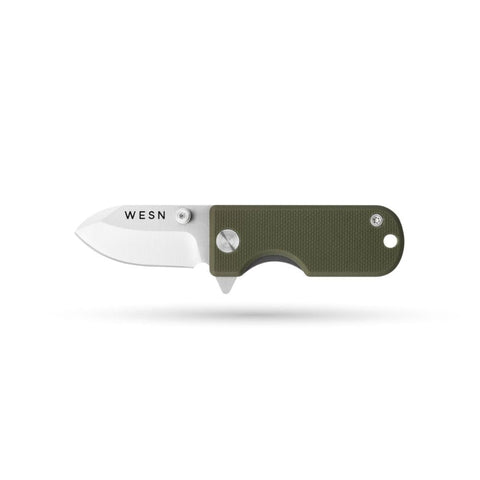
Gear that fits this hunt: the WESN Microblade for a knife that is always on you, and the Mora Kansbol Hunting for a fixed blade that does the field work.
A knife is one of the safest gifts to give a hunter, and one of the easiest to get wrong. Three knives in the Venator catalog cover the realistic range: a keychain-size folder at $89 to $99, a fixed-blade hunting knife at $59.99, and a full-tang fixed blade at $129.99. They are not interchangeable. The mistake to avoid is buying the one that looks best in the box for a job it cannot do.
Below is how the three differ on blade, steel, construction and price, and which hunter each one suits. Venator has not field-tested these knives. This comparison is built from the manufacturers' published specifications and each knife's construction, so treat it as a buying guide, not a field review.
The short version
| Knife | Price | Blade | Construction | Best for |
|---|---|---|---|---|
| WESN Microblade | $89 to $99 by finish | 1.5 in, D2 tool steel | Folding, frame lock, Grade 5 titanium | Pocket or keychain carry |
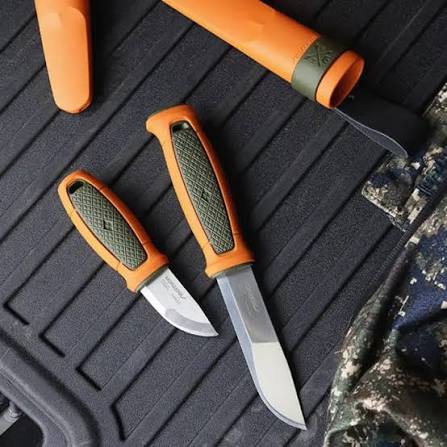
| Mora Kansbol Hunting | $59.99 | 108 mm (about 4.3 in), 2.5 mm thick, recycled Swedish stainless | Fixed blade, rubber-type handle, polymer sheath | A first or spare field knife |
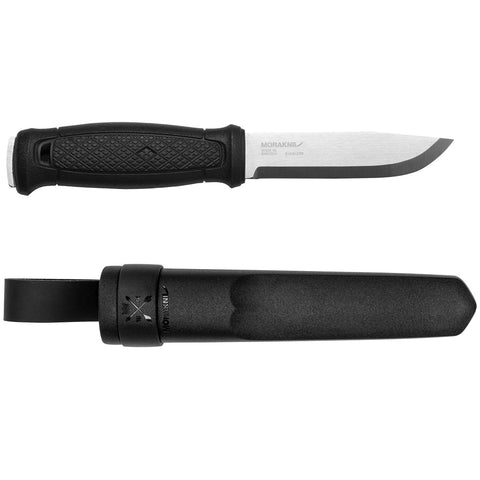
| Mora Garberg (stainless, poly sheath) | $129.99 | 109 mm (4.3 in), 3.2 mm thick, Sandvik 14C28N stainless | Full tang, Scandi grind | Hard use and camp work |
WESN Microblade: the knife that is always on you
The Microblade is built around one idea, which WESN calls availability. It is 3.75 inches long open, 2.25 inches closed and weighs about an ounce, with a 1.5-inch D2 blade, Grade 5 titanium scales (with or without a single G10 side), ceramic bearings and a frame lock. The 3.0 version added a redesigned deep-carry clip, a removable thumb stud and a reworked choil to make sharpening easier. WESN backs it with a lifetime warranty.
Finishes matter for price. The G10-and-titanium versions list at $89, and the all-titanium and blacked-out versions run $95 to $99, so check the product page for the exact finish you want.
What it will not do
A 1.5-inch blade is for cutting cord, tags, packaging and trimming, not for opening a deer. If the person you are shopping for does not already own a fixed blade, this is a second knife, not the first. WESN also notes that knife laws vary by area, so it is worth checking local rules before gifting a locking folder.
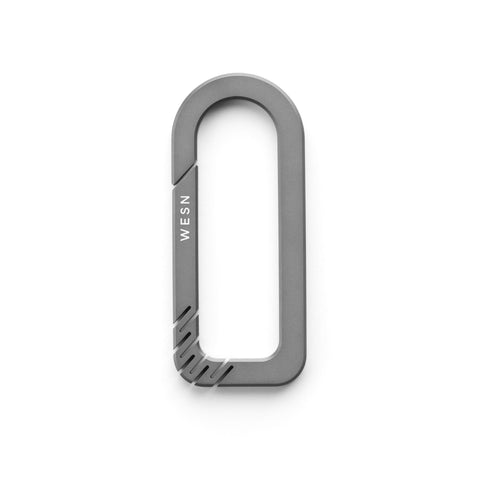
If you want a small add-on that stays with it, The CB is a $55 carabiner WESN mills from a single piece of titanium, with no springs or gates to wear out.
Mora Kansbol Hunting: the sensible fixed blade
The Kansbol Hunting is Morakniv's hunter-colored version of its all-round Kansbol, in burnt orange and olive green so it is easier to spot in dense vegetation. The blade is 108 mm long and 2.5 mm thick, ground from recycled Swedish stainless steel, on a textured rubber-type handle with a finger guard. The sheath is symmetrical polymer, so it suits left- and right-handed users, and it has a vegetable-tanned leather strap for the belt.
At $59.99 it is the easiest knife here to justify. It is a straightforward fixed blade for a hunter who does not own one, or a spare for the one who keeps losing his. The trade-off is blade thickness: at 2.5 mm it is the lighter-duty option of the two Moras, which matters if the person you are buying for likes to chop or pry. For more fixed blades at lower prices, see our hunting knives under $100 guide.
Mora Garberg: the one for hard use
The Garberg is Morakniv's full-tang knife, and the construction is the difference. The steel runs the full length of the handle rather than stopping partway, and the exposed tang at the back can be used for scraping or striking a ferro rod. Morakniv builds it from 3.2 mm Sandvik 14C28N stainless, hardened to 58 HRC, with a Scandi grind and a 109 mm blade, and describes it as tough enough for batoning.
Thickness is the practical gap with the Kansbol. A 3.2 mm blade is stiffer than a 2.5 mm one, which is why the Garberg is the better pick for a hunter who also camps, builds fires and splits kindling. At $129.99 it costs more than twice as much as the Kansbol, and for a hunter who mostly dresses game, the thinner Kansbol blade is the more economical choice. The Scandi grind is simple to maintain, and our field sharpening guide covers the basics.
How to choose
- He already owns a skinning knife: the Microblade, because a small folder is the one knife he will not already have on him.
- He does not own a fixed blade: the Kansbol Hunting, the lowest-cost way to get a real field knife.
- He wants one blade for the stand, the camp and the woodpile: the Garberg.
- You want a gift set: the Microblade and the Kansbol together come to $148.99 to $158.99, depending on the Microblade finish.
More ideas by budget are in the Hunting Gifts Under $100 collection and the wider Knives & Tools collection. For clothing gifts, see our camo gift picks by price, and for a broader list across hunting and fishing, our value-first gift guide.
Knife gift FAQ
Can the Microblade field-dress a deer?
It is not designed for that. The blade is 1.5 inches long. Field dressing and processing are fixed-blade jobs, and our hunting knives guide covers what to look for.
Is stainless or carbon steel better for a gift?
Stainless is the lower-maintenance choice for someone you are not sure will oil a blade. Morakniv describes the stainless Garberg's steel as offering excellent edge retention and requiring little maintenance.
Are these knives legal everywhere?
Not necessarily. Knife laws vary by state and locality, particularly for locking folders and blade length, and WESN advises checking your area's rules. Venator cannot advise on local law, so check before you buy.
What is the real difference between the Kansbol and the Garberg?
Construction and thickness. The Kansbol is a 2.5 mm blade on a partial-tang design at a lower price. The Garberg is a 3.2 mm full-tang blade built for harder use.