Most wader advice stops at "hunt bootfoot, fish stockingfoot." That rule of thumb is fine as far as it goes, but it skips the three things that actually decide whether a pair works for you: what the whole kit costs once you add boots, what each listing does and does not tell you about fit, and what the safety bodies say about wading in water you can't see the bottom of. This guide covers those three. If you hunt or fish the Texas coast, our Texas Gulf Coast wader guide covers materials, insulation and care, and we won't repeat it here.
A note on how this was put together: Venator has not field-tested these waders or boots. Everything below comes from the manufacturer's product listings, the live prices and size options in our store on November 2, 2026, and published safety guidance from wildlife agencies. Where a listing is silent on something you need to know, we say so rather than guess.
The design difference, in one paragraph
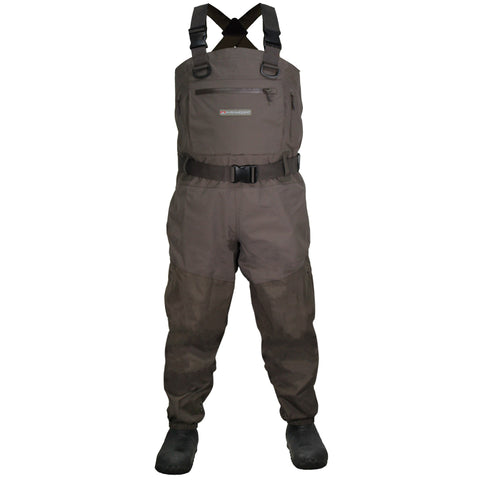
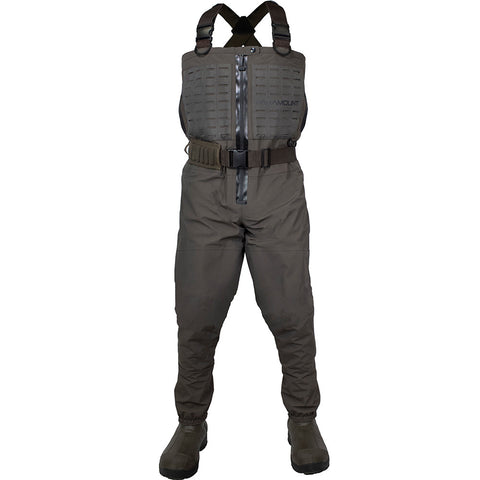
A bootfoot wader has the boot permanently attached. You buy one item, it goes on and off fast, and there are no laces to pack with mud. A stockingfoot wader ends in a neoprene sock. You wear it inside a separate wading boot, so you are buying two items and sizing two items. Every wader and boot we discuss below is from Paramount Outdoors, and Paramount's stockingfoot listings say it plainly: "This wader is designed to be worn with wading boots." The booties are not meant to be walked on alone.
Total kit cost: what you actually spend
A stockingfoot wader looks cheaper on the shelf until you add the boot. Here is the math using current Venator prices (variant prices, not sale or compare-at prices). Prices change, so check the listing before you buy.
| Kit | Wader + boot | Total |
|---|---|---|
| Bootfoot: BAYOU 3.5mm neoprene (600g insulated boots)* | $199.99 (boots attached) | $199.99 |
| Bootfoot: GWT breathable (800g insulated boots) | $299.99 (boots attached) | $299.99 |
| Bootfoot: SUMMIT breathable (1600g insulated boots)* | $349.99 (boots attached) | $349.99 |
| Bootfoot: BUFFALO breathable (1200g insulated boots)* | $349.99 (boots attached) | $349.99 |
| Bootfoot: PINNACLE zippered breathable (1200g insulated boots) | $379.99 (boots attached) | $379.99 |
| Stockingfoot: DEEP EDDY breathable* + Stonefly Cleated Wading Shoe | $179.99 – $189.99 + $89.99 | $269.98 – $279.98 |
| Stockingfoot: DEEP EDDY breathable* + Salt Flats Surf Wading Boot | $179.99 – $189.99 + $99.99 | $279.98 – $289.98 |
| Stockingfoot: DEEP EDDY breathable* + Deep Eddy Cleated Wading Boots | $179.99 – $189.99 + $109.99 | $289.98 – $299.98 |
| Stockingfoot: DEACON'S MARSH camo* + Stonefly Cleated Wading Shoe | $199.99 + $89.99 | $289.98 |
| Stockingfoot: DEACON'S MARSH camo* + Deep Eddy Cleated Wading Boots | $199.99 + $109.99 | $309.98 |
Totals are item-price subtotals and exclude tax, shipping and any separately bought wading belt.
*Held from our recommendations until the sizing data gap is closed. See "Fit data gaps" below. Prices are shown so you can do the comparison. DEEP EDDY is $179.99 in SM through 2X and $189.99 in 3X, 4X and the Stout sizes.
Three things fall out of the table:
- Stockingfoot is not automatically the budget route. A stockingfoot camo kit (DEACON'S MARSH plus a boot) lands between $289.98 and $309.98. That is within about $10 either way of the GWT bootfoot at $299.99.
- Replacement works differently. Because the boot is separate, a serviceable boot may be reusable if the wader is replaced. A bootfoot leak doesn't automatically mean replacement — repair or warranty options may exist — but the boot and wader are one item.
- Budget for a wading belt on some kits. Several listings describe a belt and several don't mention one (next section). Venator doesn't currently sell a standalone wading belt, so if your wader doesn't come with one, buy one elsewhere and add it to your total.
What comes with each wader, per the listing
| Model | Belt in listing? | Other listed extras |
|---|---|---|
| SUMMIT 1600g Bootfoot |
Yes: 2" belt with 6 shell loops | 120g removable zip-out liner; MOLLE chest panel; 6 chest pockets |
| BUFFALO 1200g Bootfoot |
Yes: 2" belt, quick-release buckles | 120g removable zip-out liner |
| GWT 800g Bootfoot |
Yes: 2" belt, quick-release buckles | Fleece-lined hand-warmer pocket; non-insulated breathable upper |
| PINNACLE 1200g Bootfoot, front zip |
Yes: 2" belt with 6 shell loops | Ti-Zip waterproof front zip; MOLLE panel with 4 D-rings |
| BAYOU 3.5mm neoprene 600g Bootfoot |
Not mentioned | Two chest D-rings; buckle-free hook-and-loop suspenders |
| DEACON'S MARSH Stockingfoot |
Not mentioned | Gravel guards with lace hooks; chest draw cord |
| DEEP EDDY Stockingfoot |
Not mentioned | Gravel guards with lace hooks; chest draw cord; flip-out pocket |
"In the listing" means the product description names the belt. Check it's in the box when your waders arrive. If it isn't, contact us before your first trip, not after.
The insulation figures belong to the boots. On the GWT, Paramount describes a "non-insulated breathable" upper with 800g Thinsulate-insulated rubber boots. The SUMMIT and BUFFALO add a removable 120g liner to the upper. All of it is passive insulation. None of these waders is heated.
Sizing: two different systems
Get this part wrong and the wader goes back, so read each listing closely.
- Stockingfoot waders use garment sizes. DEACON'S MARSH is offered in SM through 4X. DEEP EDDY is offered in SM through 4X plus Stout sizes from MD-Stout through 3X-Stout. These are body sizes. The letter alone doesn't tell you your inseam, chest or stocking-foot size. You need the manufacturer's size chart for that.
- Some bootfoot numbers are confirmed as boot sizes, some aren't. The GWT and PINNACLE listings both state "Size options are boot sizes," and both are offered in boot sizes 8–13. The SUMMIT and BUFFALO (offered in sizes 8–13) and the BAYOU (offered in sizes 8–14) use numbered sizes, but our listings don't say what the number measures, and neither does the Paramount product page we checked for the BUFFALO. Don't assume it is your shoe size until the supplier confirms it.
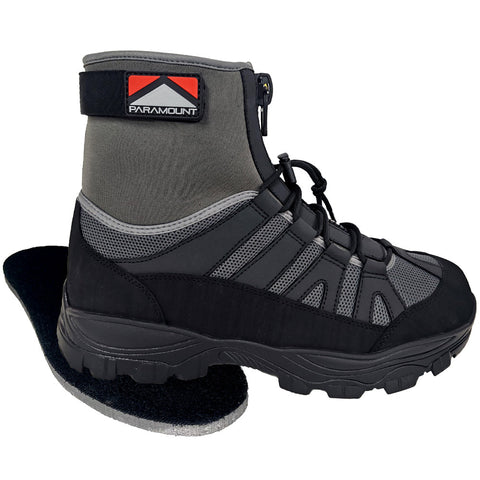
- The wading boots are sized for the bootie. The Deep Eddy Cleated, Slate SR, Stonefly Cleated and Salt Flats listings each say the boot is sized to accommodate wader booties and that you do not need to go up a size. The Deep Eddy Cleated and Slate SR are offered in 8–13, the Stonefly Cleated Wading Shoe in 8–14, and the Salt Flats in men's 8–13.
Whichever design you choose, check three things before you order: your inseam against the chart, whether you can sit down and step up without the crotch binding, and whether you have room for the socks you will actually wear. New Zealand's Department of Conservation specifically advises waders in the correct shoe size and not too long or short in the leg.
Fit data gaps: what we couldn't confirm
We would rather tell you what's missing than paper over it. As of November 2, 2026:
- DEACON'S MARSH and DEEP EDDY (stockingfoot): both listings carry a model-specific size chart; the listing text itself doesn't give inseam, chest or stocking-foot ranges, so we don't quote figures here. Check the model-specific size chart on the listing, and contact us (info@venatorhunting.com) for measurements before ordering if anything is unclear. Held from our recommendations for now.
- SUMMIT, BUFFALO and BAYOU (bootfoot): the listings don't say whether the numbered sizes are boot sizes, and Paramount's BUFFALO page doesn't either. Check the model-specific size chart on the listing, and contact us (info@venatorhunting.com) for measurements before ordering if anything is unclear. Held from our recommendations for now.
- All models: no listing gives a weight limit, a maximum safe wading depth or a temperature rating. Don't read the insulation figure as a rating.
- Puncture resistance: the SUMMIT, PINNACLE and BAYOU listings mention puncture-resistant or ripstop fabric, but none gives a test standard. None of the listings says how a model handles oyster shell. If you wade shell, ask before you buy.
Bottom type: what the sources do and don't say
We aren't going to tell you which wader belongs in soft mud, on rock or on shell, because neither the manufacturer nor the safety agencies we checked rank models that way. Here is what the published sources actually say.
- Soft mud. Virginia's Department of Wildlife Resources warns that "a deep, muddy bottom can pose serious threats" and advises avoiding water when you're unsure of the depth. No Paramount listing makes a claim about either design in deep mud. If your marsh has a soft bottom, the decision that matters is whether to wade it at all.
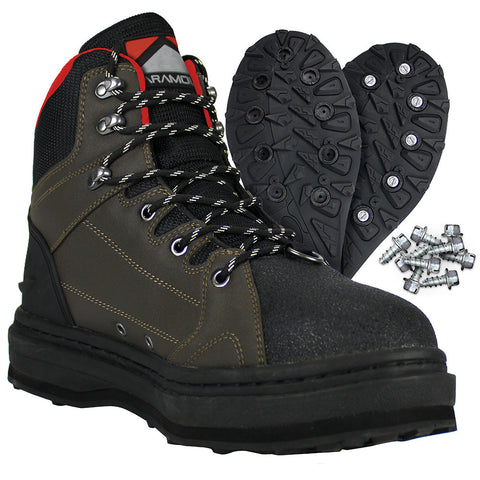
- Slick rock. Paramount says its Deep Eddy Cleated boots are built for "moving water on slick rocks or even muddy river banks" and ship with removable steel studs. It says the Slate SR's sticky rubber sole gives better traction than traditional rubber "on slick rocks in cold moving water." New Zealand's Department of Conservation notes that cobble bottoms are good footing when scoured clean but dangerous when slimy with algae.
- Salt and surf. Paramount says the Salt Flats boot is "100% corrosion resistant with zero metal," built for saltwater surf fishing, and ships with a 10mm insole so it also works for wet wading. That is the maker's description of the boot, not a statement about shell.
- Felt soles. Felt is restricted in some places. Alaska prohibits felt and other fibrous soles in freshwater sport fishing statewide, per the Alaska Department of Fish and Game. Minnesota's DNR says typical decontamination such as cleaning or chemical treatment does not work on felt, and points to rubber-soled or studded boots as alternatives. Check your state's rules before you buy felt.
The safety kit that matters more than the design
Both wading-safety agencies we checked point to the same piece of gear: a wading belt. Virginia DWR says belts "help secure the waders around your waist." New Zealand's Department of Conservation says a belt around your midriff or chest "helps to prevent water entering the lower half of waders," and for river mouths and lake edges: "Always wear a wading belt." That's why the belt column in the table above matters more than pocket count. On flotation, New Zealand DOC notes that purpose-built fishing vests "may have a ripcord which when pulled in an emergency, inflate the jacket to assist buoyancy."
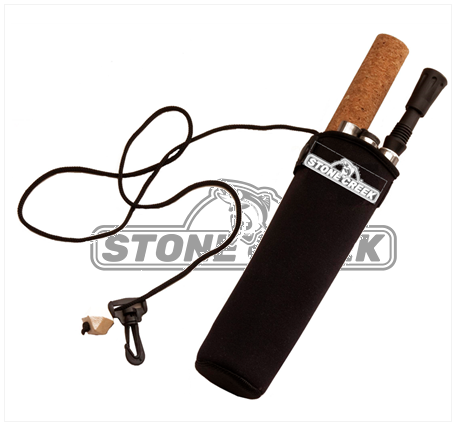
- A wading staff. Virginia DWR calls staffs "great tools for gauging water depth and adding another point of contact for improved balance." New Zealand DOC advises holding the staff upstream when you cross a river. The Stone Creek Wading Staff is a 6-piece staff that adjusts from 51" to 57" in one-inch steps.
- If you go in. Both agencies give the same basic drill: get on your back with your feet pointed downstream and work toward a safe exit. New Zealand DOC adds: stay calm, and avoid being swept into obstructions like trees where you could be pinned.
- Don't wade alone in water you don't know. Virginia DWR recommends a buddy, bright clothing and a whistle.
Where that leaves the choice
The GWT and PINNACLE listings explicitly identify their numbered sizes as boot sizes, so we can point you to them now. Body fit (inseam, chest) still needs checking against the chart. Unranked. Pick by how you hunt and fish, not by our order.
- GWT Breathable with 800g Boots, $299.99. Bootfoot, a non-insulated breathable upper, 800g insulated boots and a 2" wading belt in the listing. It's offered in boot sizes 8–13, in Brown and Bottomland. Paramount pitches it as one wader for waterfowl season and winter steelhead.
- PINNACLE Zippered Breathable Camo Wader 1200g, $379.99. Bootfoot, 1200g insulated boots, a Ti-Zip waterproof front zip that Paramount says is for easier on and off and for venting while you set decoys, and a 2" belt with shell loops. It's offered in boot sizes 8–13, but size availability varies by color, so check the listing.
If you already own stockingfoot waders and need the boot, the Stonefly Cleated Wading Shoe ($89.99), the Salt Flats Surf Wading Boot ($99.99) and the Deep Eddy Cleated Wading Boots ($109.99) are all listed as sized for wader booties. Match the sole to what the manufacturer and your state's rules say, using the section above.
Browse more in our waterfowl and duck hunting and fly fishing collections.
Related reading
- Texas Gulf Coast waders: duck marshes and wade fishing
- Steel, bismuth or TSS for ducks: the math behind the $5 shell
- The single-reed duck call worth buying in a down-mallard year
- Arkansas rice-field duck hunts and the WRICE draw
- How to fish big browns in the fall
Sources
- Paramount Outdoors product pages for the GWT and BUFFALO, retrieved Nov. 2, 2026. Other product details are from the Paramount product descriptions on our listings.
- Virginia Department of Wildlife Resources, "Wade Well," June 2025.
- New Zealand Department of Conservation, "Wading safety," Taupō Fishery.
- Alaska Department of Fish and Game, "Alaska's Ban on Felt Soled Wading Footwear: FAQ," 2012.
- Minnesota Department of Natural Resources, "Felt-soled waders."
Venator staff